

Digital Family Office Operations: From Islands to an End-to-End Architecture
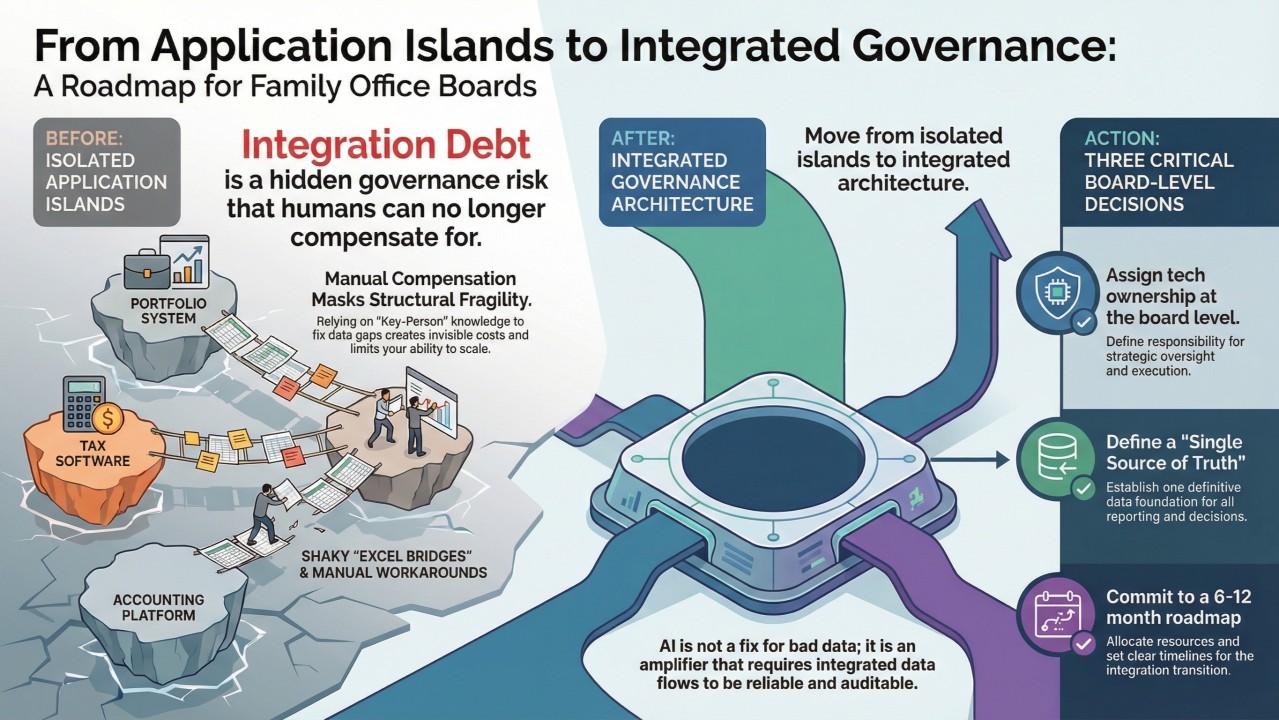
In conversations with family offices about operational challenges, I often see the same pattern: digitalisation is well advanced, but rarely guided by a coherent end-to-end strategy. Most investment happened in a problem-driven, ad hoc way: portfolio management, securities accounting, financial accounting, DMS/archiving, tax, reporting. Each solution makes sense on its own. In combination, however, the result is often not an integrated operating model or an overall architecture. Instead, a network of application and data islands grows, held together by MS Excel bridges.
Operationally, this can work surprisingly well for a long time. The true cost often stays hidden, because in most cases there are enough resources and teams close the gaps: Excel models, email, manual reconciliation between applications and files, implicit knowledge.
A setup that stays stable only through manual braces does not become truly robust. It is simply compensated by people.
How sustainable will application islands be?
From a board perspective, a short reality check is worthwhile:
- Traceability: Can we explain key figures end-to-end and in a timely manner, from portfolio management through securities accounting to the financial statements?
- Value creation: Does the family office gain operational efficiency, or only more manual coordination between islands?
- Scalability: What happens with additional mandates (for example at MFOs), structures, or asset classes? Does the model scale, or does the reconciliation effort scale?
- AI readiness: Are there clear definitions, data ownership, and logging so AI can deliver reliable outcomes?
- Ecosystem pressure: Can new requirements from banks, custodians, and auditors be met without structural extra effort?
These questions point directly to the core issue: application and data islands create technical debt. I call this integration debt, meaning recurring cost and risk because data flows are not integrated end-to-end and are instead compensated manually.
Integration debt: the invisible risk in daily operations
Every application brings its own logic: master data, definitions, approvals. In isolation, that is manageable. In combination, structural risk emerges, because connections across systems must repeatedly be built by hand.
The typical moment comes when a “simple” question needs a consolidated answer. The process then starts, often across several functions: export, reconcile, interpret, reformat, in many cases as manual tasks handled by different experts. This repeats with every new reporting format, every ad hoc board request, or every control requirement from the custodian.
In daily operations, inefficiencies often stay invisible, because employees routinely compensate for them. They become visible once speed, precision, or audit depth need to increase.
Consequences
When integration debt bites, it is not primarily an efficiency issue. It is a steering and control issue:
- Time loss: Resources flow into data preparation instead of analysis and decision support.
- Error risk: Manual transfers and room for interpretation increase deviations; additional interfaces without clear controls amplify this.
- Key-person risk: Data flows and logic are often insufficiently documented and depend on individuals.
- Lack of scalability: New structures and requirements increase effort disproportionately.
For boards, these are classic risk categories: dependencies, controllability, and resilience.
AI exposes the foundation. It does not solve the underlying problem
AI can accelerate reporting, answer questions, detect deviations earlier, and improve monitoring. The potential is considerable. AI is no substitute for consistent data management, though. It amplifies what is already there, including inconsistencies and data errors.
As soon as AI produces outputs that prepare decisions or influence reports, one question becomes central: can we explain, in a traceable way, how the result came about?
Without clear data ownership, documented data flows, defined terms, approvals, and logging, that is difficult. This level of traceability is increasingly expected, from regulators as much as from the ecosystem: banks, custodians, auditors, and service providers.
Future opportunity: AI as a bridge between operations and the board
Today, a great deal of knowledge sits in operations, spread across individuals: in files, emails, process know-how, years of experience, and manual consolidations. The board sees the condensed view, often delayed and only partly verifiable. At the same time, dependency on individual key people creates additional risk.
With an integrated data foundation, AI can reduce this information asymmetry: board Q&A on a secured data basis, less dependency on key people, earlier detection of deviations, and monitoring with clear thresholds and escalation. Without an integrated data foundation, that level of quality is not achievable.
Three board decisions for a new architecture
Continuing the current path, with more point solutions and more Excel bridges, does not reduce the risk. Three board decisions can make ownership, governance, and target architecture binding, and set a forward-looking course:
Anchor ownership and technology competence at executive and board level
Digital steering is governance. Board questions:
- Who carries end-to-end responsibility for data, interfaces, and controls?
- Is the board’s technology and data competence sufficient to assess architecture and AI decisions, including cyber risk?
- Which KPIs and agenda items ensure the topic is steered on an ongoing basis?
Start data governance as an operating model
Start with the most critical data objects, not with the big bang. Board questions:
- Which data objects are central to reporting and the financial statements, and which system is the “system of record” for each?
- Which definitions are binding?
- Which minimum controls apply, for example validations, approvals, or change logs?
Define the target architecture before investing further
“Single source of truth” is not software. It is an architectural decision. Board questions:
- Where will consolidation happen in future, and with which controls?
- Which manual chains are acceptable, and which must be eliminated?
- Which roadmap delivers measurable effects within six to twelve months, for example less reconciliation, faster closes, or better audit trails?
Personal conclusion
I repeatedly see operational teams keep a complex setup stable through experience and strong personal commitment. It often works surprisingly well. The problem: stability then depends not on the system. It depends on people, routines, and “silent” Excel chains. That is hard for a board to steer: risks become visible late, controls are difficult to reproduce, and every round of scaling makes the model more effortful rather than simpler. Liability and responsibility often remain unclear.
Once data ownership, definitions, and architecture are properly and bindingly clarified, the dynamic changes fundamentally: less manual reconciliation, traceable reports, clear approvals. AI can then become real support for steering, instead of an additional source of uncertainty.
I support family offices and boards with a focused assessment and a prioritised roadmap. It reduces technology and integration debt, stabilises controls, and delivers impact within six to twelve months. This creates the foundation for future digital transformation and the use of AI.