

If You Work Like a Robot, You Will Be Replaced by a Robot
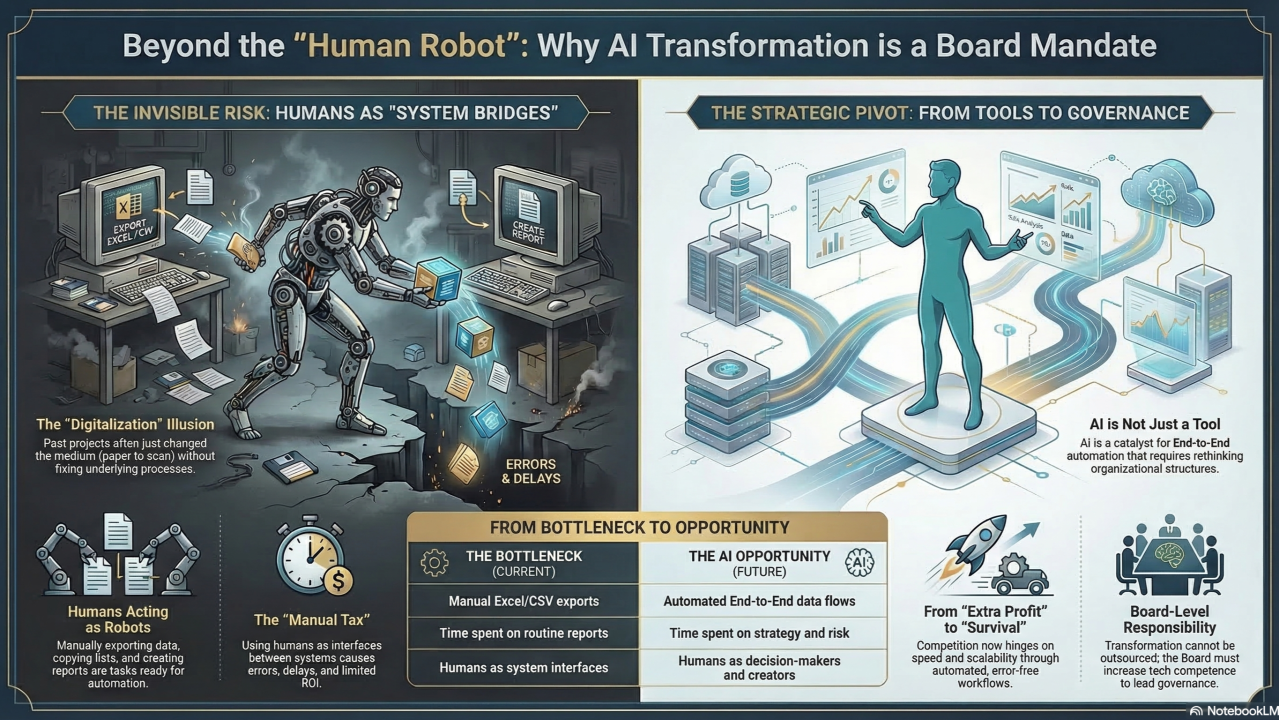
This sentence is uncomfortable. It is not primarily about technology. It is about organisations, processes and accountability, and about a pattern that has worked in many companies for years but is now reaching its limits in the next phase of transformation.
The last wave of digitisation often looked “successful.” Was it really?
Over the past 10 to 15 years, many organisations have completed digitisation projects: systems were introduced, tools replaced, platforms modernised. On paper, this often looked like success.
In practice, however, a recurring pattern emerged:
- Where processes should really have been redesigned, manual workarounds appeared instead.
- Where interfaces were missing, work was “integrated” through Excel, email and copy-paste; documents were printed and scanned again, or data was moved via text files and CSVs.
- Where responsibilities should have been redefined, they were left untouched to avoid internal conflict and preserve established “kingdoms.”
- Where long-standing processes should have been documented and challenged, they were simply continued, with a new application layer placed on top.
These patterns are also a result of the past. Digitisation often meant primarily a change of medium. Letters became faxes, then emails. Paper files became scans and electronic archives. Handwritten notes were later typed on a typewriter, then printed from a computer and filed as documents in a DMS. In many cases, though, the underlying process stayed largely the same.
This is not an accusation. It is a pragmatic reality. Many organisations “fudged” their way through digitisation to stay operational, avoid conflict, and leave the underlying structure untouched, often without ever truly needing to understand digital operating logic. Not infrequently, the topic could be delegated safely out of sight, to IT departments and external partners, along with a perceived transfer of accountability.
The cost of this is well known: limited economic benefit, a modest ROI, and a high proportion of manual work that exists only because processes and data flows were never resolved consistently.
Generative AI is exposing the problem, and suddenly making it solvable
Since the breakthrough of generative AI, at the latest since the end of 2022, the starting point has changed. Many employees now use AI to write, structure or analyse faster. That looks efficient.
But in many cases, the human remains the interface, and therefore effectively the “robot” between systems.
The typical workflow in many organisations:
- Data sits in System A.
- Someone exports or copies it.
- Someone turns it into lists, reports or presentations.
- Someone interprets the result and drafts a basis for decision-making.
- And in the end, someone manually records it again in System B.
In some cases, data is still moved via decades-old exchange mechanisms such as CSV files: functional, but driven by the same old process mindset. This is not even an exaggeration. It is still everyday reality in many organisations.
This is precisely the turning point: these activities are not only inefficient and error-prone; they are increasingly automatable. That is not only true for large cloud models. Smaller, locally deployable models do it just as well, combined with workflow automation, well-ordered data management and clear governance.
The key insight: AI is not a tool. It is an accelerator for end-to-end automation, provided organisations think through structure and process consistently.
The centre of gravity is productivity and purpose, not headcount cost
The debate is often framed the wrong way: “How many roles can we cut?”
The more strategic question is: how do we increase productivity and quality, and where do we deploy scarce resources most sensibly?
Because let’s be candid:
Is it really meaningful work to retype receipts? To copy content from one window into another? To run Excel as an integration layer? To assemble quarterly reports from manual groundwork?
For most roles, the answer is: no.
The bottleneck in most organisations is rarely “too little work.” The bottleneck is:
- too little time for prioritisation,
- too little time for sound risk assessment,
- too little time for training and development,
- too little time for customers, product and quality,
- too little time for leadership and change.
AI can ease this pressure. But that only holds if companies do not stop at the tool. They have to redesign the process itself.
Looked at soberly: even where headcount stays stable, role profiles and skill sets will change significantly. This is precisely where the mistakes of the past must not be repeated. Change has to be actively led. Otherwise, companies risk a skills gap that can pull the organisation apart: on one side, those who understand the technology and want to drive it forward; on the other, people who feel overrun, grow anxious and start to block progress. If leadership does not steer this clearly, organisational climate and culture suffer. In the end, companies lose precisely the employees who carry experience and critical knowledge, the very qualities AI cannot replace.
The real competition: who operationalises faster?
Many organisations hope they can keep their established structures. In the short term, that is often possible.
The market does not reward comfort or preference. It rewards speed and capability. When competitors automate end-to-end processes, cycle times, error rates and costs fall, while scalability and responsiveness rise at the same time. That shifts the ROI question quickly:
- previously: “Will this generate additional profit?”
- going forward: “Will this keep us competitive?”
- in the extreme case: “Will we survive in the long term?”
This does not affect companies alone. It affects employees too: those whose work consists mainly of routine tasks will come under pressure. Those who take responsibility, prioritise, decide, create something new, maintain personal relationships with customers and colleagues, and generate impact will come out ahead.
Why the board and executive team need to act now
AI transformation is not “an IT project.” It is a structural and organisational question:
- Which decisions can and should be automated?
- Who carries accountability, professionally, legally, operationally?
- What data do we have, and where is it permitted to go?
- How is quality evidenced, through traceability and auditability?
- What structures do we need to deliver the transformation?
- How do we integrate existing islands instead of creating new ones?
These are strategy and governance questions. They belong clearly at board and executive level.
The board does not need to implement the transformation itself. But it must:
- demand it,
- structure it,
- make it measurable,
- and ensure that risk, compliance and resilience are built in, and that employees are supported and enabled throughout the process.
At the same time, executive teams and boards need to deliberately raise their own technology and digital competence, so they can ask the right questions in the first place. This phase of transformation, at the strategic level, and the accountability that comes with it, cannot be outsourced to IT or service providers.
Whoever stays passive here will eventually get the transformation imposed from outside: by the market, by regulation, by pressure on employer attractiveness, or by cost.
If you work like a robot, you will be replaced by a robot. That applies to employees just as much as to companies and public institutions.
Who is seeing similar challenges emerge in their own organisation?
In closing
I lead and support organisations through interdisciplinary, multi-perspective and critical thinking. I combine values-based leadership with clarity, judgement and resilience, in demanding transformations, organisational challenges and complex decision-making at the intersection of strategy, technology and governance.