

Why AI projects fail and what it says about the organisation
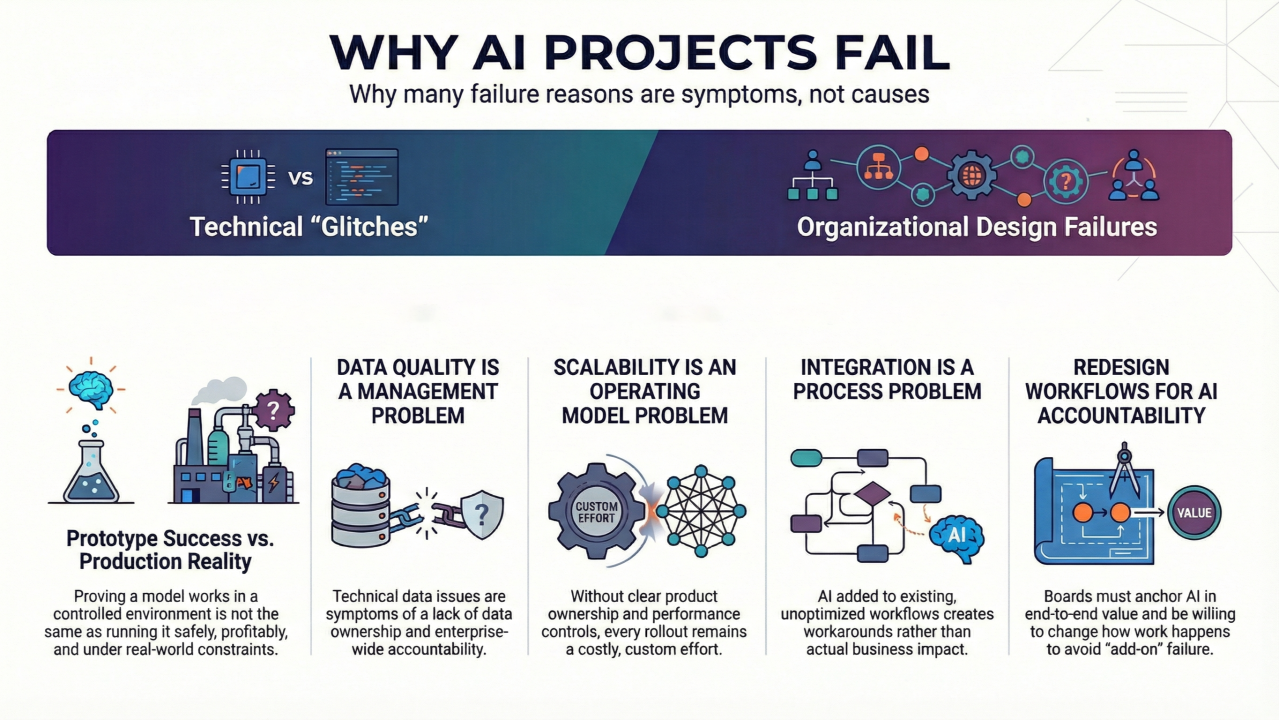
Many organisations can build an impressive AI prototype. The model performs. The demo convinces. The business case looks promising.
Then the initiative stalls.
When this happens, the explanations sound technical: data quality, scalability, integration. These are real issues, but in most cases they are not the root causes. They are visible outcomes of deeper organisational patterns.
The uncomfortable truth: AI does not fail because the organisation lacks capable people. It fails because the organisation is not designed to convert a promising prototype into repeatable, controlled value at scale. In many cases, decisions made under time pressure early in the project create the obstacles that surface later.
The difference between a prototype and a business capability
A prototype proves that something can work in principle. It is built in a protected environment: curated data, motivated experts, simplified assumptions and minimal governance friction.
A production solution operates under real-world constraints: messy data, exceptions, security requirements, regulatory expectations, process ownership, accountability, and users who are measured on outcomes rather than innovation.
“We proved it works” is not the same as “we can run it safely and profitably.”
Why many failure reasons are symptoms, not causes
“Data quality wasn’t good enough.”
This is usually not primarily a technology problem. It is often a leadership and governance challenge. Most organisations do not suffer from a lack of data. They suffer from a lack of data ownership. Often, no one holds the enterprise-wide mandate to define what data means, who may change it, how quality is measured, and what happens when it drops. Definitions were made locally, within individual departments and functions.
The result is predictable: every AI initiative spends most of its time cleaning data, negotiating definitions, and rebuilding datasets that already exist elsewhere in a different form.
“The solution wasn’t scalable.”
Scalability is rarely about the model. It is about whether the organisation has built the capability to deploy, monitor and continuously manage AI as it would any other critical business system.
A prototype is a project. A scalable solution is a product with an operating model: clear ownership, performance controls, ongoing maintenance and predictable cost. Without that operating model, every rollout becomes a custom effort, and scaling becomes economically unattractive.
“We couldn’t integrate the solution into our business.”
This is the most revealing symptom. It typically means the organisation tried to add AI on top of existing workflows without changing how work actually happens. This follows a pattern seen in earlier digitalisation cycles, where the medium changed but the process did not. The same people continue the same work in the same place.
Integration is not primarily an IT topic. It is a process and accountability topic. AI changes decision-making, handovers, controls, exception handling and responsibilities. Where these are not redesigned, the organisation creates workarounds: people bypass the tool, duplicate work for safety, or revert to manual decisions under pressure. The system may technically exist. It does not produce impact.
The underlying pattern: digitalisation without a holistic design
Two patterns appear consistently when organisations review their digital history:
- Some initiatives were built bottom-up. Individual functions improved locally and created real progress, but results stayed in silos because data and processes were not designed end-to-end.
- Others were driven top-down, focused on the highest short-term return on investment. This delivered quick wins but optimised isolated parts of the value chain rather than the whole.
Both are understandable. The problem arises when neither approach is complemented by an enterprise-wide design: a shared process view, a coherent data model, clear governance and leadership alignment across organisational boundaries.
What needs to be true before AI can scale
AI works best when leaders follow a horizontal approach, not a departmental initiative. Three leadership decisions matter.
- First, AI must be anchored in end-to-end value creation. The priority should be the value chain: where decisions, quality, time and risk can be improved across functions, not just within a single team.
- Second, accountability must be clear and individually owned, not collectively assumed. Successful AI delivery requires business ownership, technology delivery and risk oversight to be distinct responsibilities, held by named leaders, working within one integrated governance structure. Where these responsibilities are fragmented or left to committees, decision-making slows, accountability diffuses, and the organisation struggles to maintain pace, quality and risk discipline across the full delivery lifecycle.
- Third, leaders must be willing to redesign workflows and roles. AI changes work. Where the organisation insists that existing processes remain untouched, AI becomes an add-on. Add-ons rarely survive operational reality.
The biggest blocker is often organisational debt
Ambition is rarely the limiting factor. Most organisations carry significant technical and managerial debt: fragmented systems, unclear data lineage, manual controls and exceptions handled through informal knowledge.
In the short term, a human workaround appears cheaper than fixing the foundation. In the long term, it creates opportunity costs, operational risk and a growing complexity tax.
This is why many AI initiatives cannot deliver at scale: they are built on unstable ground.
The board-level and executive question
When an AI prototype succeeds but the rollout fails, the temptation is to blame the model or the team.
The better questions are:
- Are we building AI as a one-off initiative, or are we building the organisational capability to run AI safely, repeatedly and at scale?
- Do we understand that short-term ROI optimisation compounds long-term costs, management debt and competitive disadvantage?
AI will increasingly become part of core business processes. That requires the same discipline as any other critical capability: clear ownership, operating controls and leadership through change.
Where those conditions are met, data quality improves, integration becomes feasible, and scaling becomes a management decision rather than a technical gamble.